

| Case Report Online Published: 30 May 2025 | ||||||||||||||||||||||||||||||
Case Rep Ser Med. 2025; 2(2): 32-35 Cerebral Toxoplasmosis: Effectiveness of Clindamycin Monotherapy in a Patient with Sulfonamide Allergy Margareth Hildaria, Gabriel Alden Setiawan.
| ||||||||||||||||||||||||||||||



Introduction
Cerebral toxoplasmosis, caused by the protozoan Toxoplasma gondii, is a severe and often fatal complication of HIV disease, especially in developing countries with limited healthcare services. Globally, approximately 13.1 million individuals living with HIV (people living with HIV) are co-infected with T. gondii with 25.1% occurring in Asia and the Pacific, highlighting the importance of early diagnosis and treatment by considering cerebral toxoplasmosis as a potential early sign of HIV infection [1]. Standard treatment involves a combination of drugs such as pyrimethamine and sulfadiazine, which have significant adverse effects that complicate patient management. Clindamycin, an antibiotic with known activity against T. gondii, has emerged as a potential alternative due to a lower incidence of adverse effects. However, its use as a monotherapy for cerebral toxoplasmosis is rare, and published data on its efficacy are limited.
Case Report
A 34-year-old man presented with progressively worsening headaches over the past 3 days, with a pain scale of 7–8 (numeric rating scale), photophobia, dizziness, nausea, vomiting, and slurred speech. He had no prior history of HIV, or of respiratory or gastrointestinal symptoms. On physical examination, the patient was stable, with a Glasgow Coma Scale score of 15, blood pressure of 123/77 mmHg, heart rate of 77 bpm, respiratory rate of 21/min, temperature of 36.5°C, and oxygen saturation of 98% on room air. Neurological examination revealed left-sided central VII and XII cranial nerve palsies, but motor function, physiological reflexes, and pathological reflexes were all normal.Laboratory tests showed a normal white blood cell count with a slight increase in neutrophils. The patient tested positive for HIV, confirmed by a reactive rapid HIV test and an immunoglobulin G(IgG) anti-toxoplasma level exceeding 300 IU/ml.
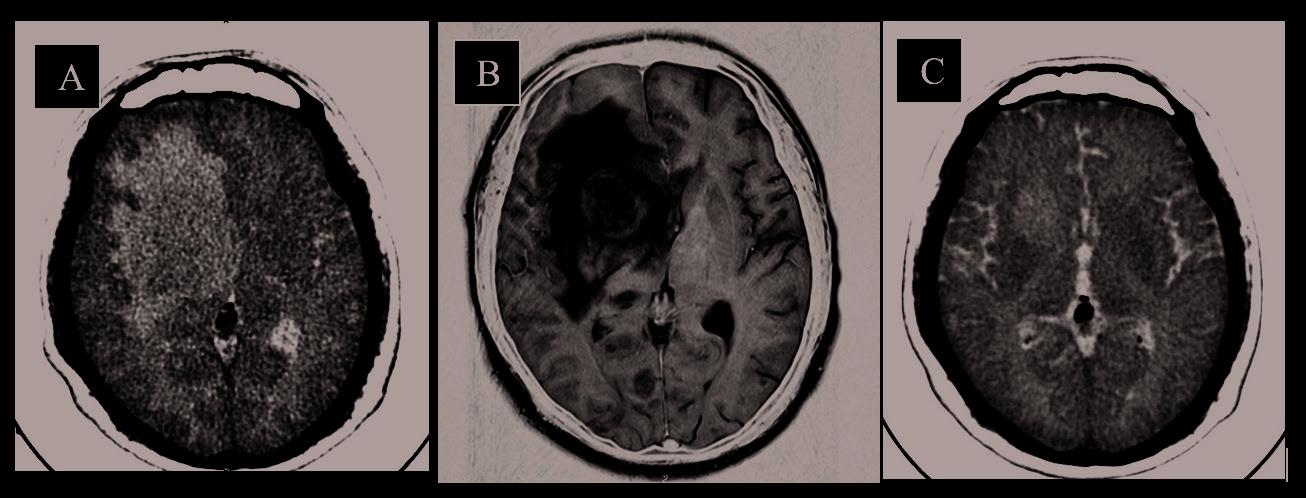
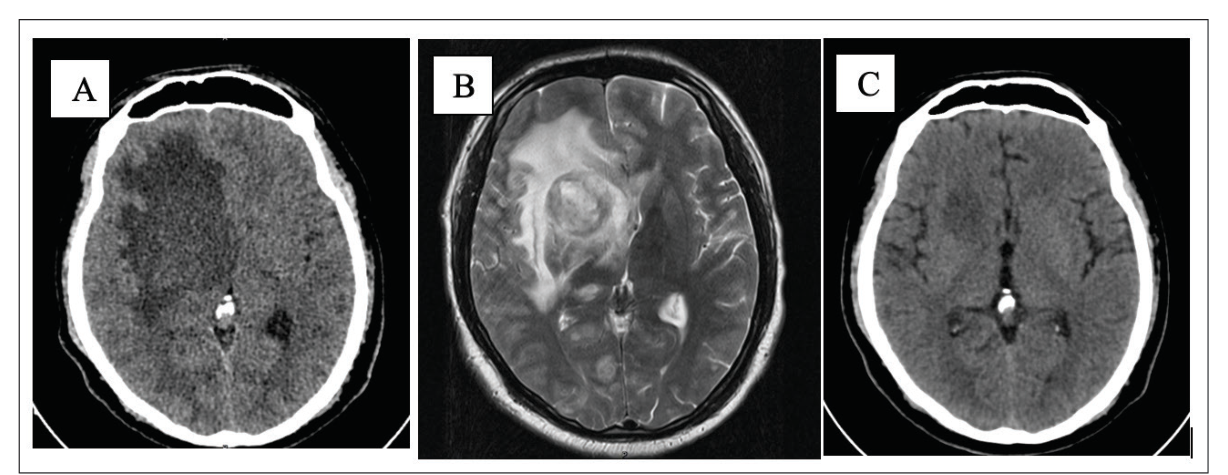
The results of chest radiography were normal. A non-contrast head CT scan revealed a suspected space-occupying lesion (SOL) in the white matter of the right frontotemporal lobe, right periventricular lateral, right caudate nucleus, right internal capsule, right lentiform nucleus, and right external capsule, with vasogenic edema narrowing the right lateral ventricle and third ventricle, causing a midline shift of 0.71 cm to the left. A brain MRI with contrast confirmed multiple ring-enhancing nodules in the same regions and additional nodules in the white−grey matter of the bilateral frontotemporoparietooccipital lobes, bilateral basal ganglia, bilateral periventricular areas, bilateral cerebellum, and pons, with a midline shift of 0.89 cm to the left (Fig. 1).Due to the patient’s allergic reaction to sulfonamides and the unavailability of pyrimethamine, the patient was treated with clindamycin, folic acid, citicoline, and paracetamol. At present, the availability of pyrimethamine in various health service centers is increasingly limited following the 2020 decision by the Indonesia National Agency of Drug and Food Control to halt its production. Given the significant mass effect, as indicated by the midline shift and worsening headaches, the patient received intravenous steroids. By the third day of inpatient care, the patient’s headache severity decreased to a pain level of 2–3, dizziness improved, and nausea and vomiting were resolved. Clindamycin was continued for approximately 6 weeks during the acute phase. Throughout the treatment period, the patient experienced no adverse effects related to medication. A follow-up non-contrast head CT scan showed resolution of the edema, no further midline shift, and a significant reduction in the size of the lesion compared to the initial scan (Fig. 1).
Discussion
Cerebral toxoplasmosis is one of the most common causes of intracranial mass lesions in HIV-positive patients. Diagnostic criteria include HIV-positive status, history taking and neurological physical examination revealing the presence of an SOL, CD4+ count < 200, positive IgG T. gondii with positive IgG toxoplasma titer, and diagnostic tests: non-contrast head CT scan shows vasogenic edema or mass lesions in the brain, contrast-enhanced head CT scan/MRI shows brain mass lesions with ring enhancement, multiple lesions, diffusion-weighted imaging hypointense or diffuse edema, definitive diagnosis can only be made with histological biopsy, and clinical or radiological improvement in response to anti-toxoplasma therapy after 2 weeks in patients with edema and intracranial mass [2–4].In our patient’s case, cerebral toxoplasmosis was diagnosed after presenting with neurological symptoms and characteristic brain lesions on a CT scan. A positive rapid HIV test, along with a high IgG anti-toxoplasma level (>300 IU/ml), supported the diagnosis of cerebral toxoplasmosis in the context of previously undiagnosed HIV infection. This case
exemplifies that cerebral toxoplasmosis can be the initial manifestation of an HIV diagnosis, underscoring the ethical imperative for healthcare providers to maintain a high index of suspicion for HIV in patients presenting with neurological symptoms, especially in those with risk factors but without a prior HIV diagnosis. Early recognition is crucial to initiate timely treatment and counseling and to address the patient’s broader health needs, including HIV management and prevention of further transmission [5,6].In resource-poor settings where access to standard treatments such as pyrimethamine is limited, and in cases where patients have allergies to sulfonamides, clindamycin offers a valuable alternative for treating cerebral toxoplasmosis. For our patient, clindamycin was started as the sole treatment due to the patient’s sulfonamide allergy and the unavailability of pyrimethamine. Remarkably, within 72 hours, there was a significant improvement in neurological condition, underscoring clindamycin’s potential efficacy as monotherapy. Similar findings were reported by Madi et al. [7], where a patient exhibited rapid clinical improvement within 48 hours of starting clindamycin, with complete resolution of lesions in 3 weeks. Yapar et al. [8] also reported the successful use of clindamycin as monotherapy for cerebral toxoplasmosis in an HIV-positive patient allergic to sulfonamides [8].Clindamycin, a lincosamide antibiotic, shows in vitro activity against T. gondii and demonstrates inhibitory effects in vivo at lower concentrations. Within 3 days, a concentration of approximately 1 ng/ml of clindamycin can reduce the multiplication of T. gondii by 50% [9,10]. Fichera et al. [11] demonstrated that clindamycin can inhibit the growth of T. gondii even at low concentrations, suggesting that it can effectively target the parasite in both its active and dormant stages. Furthermore, studies have shown that clindamycin can penetrate the blood−brain barrier, a crucial factor in the treatment of cerebral infections. Gatti et al. [12] showed that clindamycin, along with its metabolite N-desmethyl clindamycin, could reach therapeutic concentrations in the cerebrospinal fluid (CSF) of AIDS patients. Although the penetration ratio of clindamycin through the blood-brain barrier is relatively low, the concentrations achieved in CSF exceed the parasitical thresholds, and it is hypothesized that clindamycin may be actively transported into infected brain tissue by phagocytic cells, enhancing its local efficacy.
The standard approach for treating cerebral toxoplasmosis involves a combination of pyrimethamine and sulfadiazine, which continues to be the most effective regimen, especially for preventing relapse over the long term. In contrast, using clindamycin alone as monotherapy is less well established and generally considered inferior to combination regimens. Additionally, there is limited evidence from randomized clinical trials supporting clindamycin monotherapy, and concerns remain about the potential resistance development and relapse risk.Although several case reports document clinical improvement with clindamycin monotherapy, these instances often involve extended treatment periods and inconsistent timelines for radiological resolution; for example, one patient required up to 10 months for complete lesion clearance [1,8]. Common side effects of clindamycin include gastrointestinal issues and, infrequently, Clostridioides difficile infection, necessitating careful monitoring during prolonged use [1]. The need for longer treatment durations with clindamycin monotherapy may also increase the risk of adverse events and reduce patient adherence.It is also important to note that cerebral toxoplasmosis can present in various forms, sometimes mimicking other conditions such as stroke [13–16].
Kang et al. [17] reported a case where cerebral toxoplasmosis was initially misdiagnosed as a stroke due to the similarity in imaging findings, underscoring the need for heightened clinical suspicion, especially in HIV-positive patients with unexplained neurological symptoms. Comprehensive diagnostic workups, including serological tests for T. gondii and detailed imaging studies, are essential in such cases [18–21].
Conclusion
This case highlights the need for healthcare providers to consider HIV testing in patients with unexplained neurological symptoms, particularly in regions with a high prevalence of HIV and when cerebral toxoplasmosis is suspected. Early identification of HIV infection is essential for timely initiation of appropriate treatment and improved patient outcomes. Although the combination of pyrimethamine and sulfadiazine remains the established gold standard, clindamycin has demonstrated the ability to penetrate the blood−brain barrier, its proven in vitro support anti-Toxoplasma gondii activity, and documented clinical successes in case reports support its use as either monotherapy or in combination with other agents. Given the challenges posed by sulfonamide allergies and limited drug availability in some settings, clindamycin represents a promising alternative. However, further well-designed clinical studies are needed to clarify its efficacy, optimal dosing, and safety profile, particularly as a potential first-line treatment option for cerebral toxoplasmosis in immunocompromised patients.
Acknowledgment
Gratitude is extended to all neurologists at Murni Teguh Sudirman Jakarta Hospital for their invaluable support in preparing this manuscript.
References1. Wang ZD, Wang SC, Liu HH, Ma HY, Li ZY, Wei F, et al. Prevalence and burden of Toxoplasma gondii infection in HIV-infected people: a systematic review and meta-analysis. Lancet HIV 2017; 4(4):e177–88.2. Basavaraju A. Toxoplasmosis in HIV infection: an overview. Trop Parasitol 2016; 6(2):129–35; doi:10.4103/2229-5070.1908173. Dian S, Ganiem AR, Ekawardhani S. Cerebral toxoplasmosis in HIV-infected patients: a review. Pathog Glob Health 2023; 117:14–23.4. Vidal JE. HIV-related cerebral toxoplasmosis revisited: current concepts and controversies of an old disease. J Int Assoc Provid AIDS Care 2019; 18:2325958219867315.5. Fard SA, Khajeh A, Khosravi A, Mirshekar A, Masoumi S, Tabasi F, et al. Fulminant and diffuse cerebral toxoplasmosis as the first manifestation of HIV infection: a case presentation and review of the literature. Am J Case Rep 2020; 21:e919624.6. Hernandez AV, Thota P, Pellegrino D, Pasupuleti V, Benites-Zapata VA, Deshpande A, et al. A systematic review and meta-analysis of the relative efficacy and safety of treatment regimens for HIVassociated cerebral toxoplasmosis: is trimethoprim-sulfamethoxazole a real option? HIV Med 2017; 18(2):115–24.7. Madi D, Achappa B, Rao S, Ramapuram JT, Mahalingam S. Successful treatment of cerebral toxoplasmosis with clindamycin: a case report. Oman Med J 2012; 27:411–2.8. Yapar N, Erdenizmenli M, Oǧuz VA, Çakir N, Yüce A. Cerebral toxoplasmosis treated with clindamycin alone in an HIV-positive patient allergic to sulfonamides [3]. Int J Infect Dis 2005; 9:64–6.
9. Shiojiri D, Kinai E, Teruya K, Kikuchi Y, Oka S. Combination of clindamycin and azithromycin as alternative treatment for toxoplasma gondii encephalitis. Emerg Infect Dis 2019; 25:841–3.10. Ting SW, Liu JW. Combination of trimethoprim-sulfamethoxazole and clindamycin in the treatment of relapsing toxoplasmic encephalitis. J Microbiol Immunol Infect 2024; 57:518–9.11. Fichera ME, Bhopale MK, Roos DS. In vitro assays elucidate peculiar kinetics of clindamycin action against Toxoplasma gondii. Antimicrob Agents Chemother 1995; 39:1530–7.12. Gatti G, Malena M, Casazza R, Borin M, Bassetti M, Cruciani M. Penetration of clindamycin and its metabolite N-demethylclindamycin into cerebrospinal fluid following intravenous infusion of clindamycin phosphate in patients with AIDS. Antimicrob Agents Chemother 1998; 42:3014–7.13. Philip-Ephraim EE, Charidimou A, Williams E, Kajogbola G. Stroke-like presentation of cerebral toxoplasmosis: two HIV-infected cases. Cerebrovasc Dis Extra 2015; 5(1):28–30.14. Khosla A, Singhal S, Jotwani P, Kleyman R. Cerebral toxoplasmosis as the initial presentation of HIV: a case series. Cureus 2022; 14(3):e23359.15. Vidal JE, Rivero RLM, de Sousa dos Santos S, Guedes BF, Gomes HR, Penalva de Oliveira AC, et al. Case report: calcified cerebral toxoplasmosis associated with perilesional edema in people living with HIV/AIDS: case series of a presentation mimicking neurocysticercosis. Am J Trop Med Hyg 2022; 106(5):1426–33.16. Awang Senik NIS, Halim SA, Sapiai NA. A case of cerebral toxoplasmosis: “eccentric and concentric sign” in MRI. IDCases 2023; 33:e01824.17. Kang Y, Zhang X, Zhang L, Huang M, Tang C, Zhang L. Cerebral toxoplasmosis mimicking stroke in a woman living with undiagnosed HIV. J Infect Public Health 2024; 17(8):102477.18. Azovtseva OV, Viktorova EA, Bakulina CG, Shelomov AS, Trofimova TN. Cerebral toxoplasmosis in HIVinfected patients over 2015-2018 (a case study of Russia). Epidemiol Infect 2020; 148:e14219. Dunphy L, Palmer B, Chen F, Kitchen J. Fulminant diffuse cerebral toxoplasmosis as the first manifestation of HIV infection. BMJ Case Rep 2021; 14(1):e919624.20. Zawadzki R, Modzelewski S, Naumowicz M, Matyja AM, Urbaniak AD, Zajkowska J, et al. Evaluation of imaging methods in cerebral toxoplasmosis. Pol J Radiol 2023; 88:389–98.21. Basmalah AN, Sugianto P. Significant clinical outcome using pyrimethamine and clindamycin in cerebral toxoplasmosis with severe edema: a case report. Ann Med Surg 2023; 85(4):1034–7.
| How to Cite this Article |
| Pubmed Style Hildaria M, Setiawan GA. Cerebral Toxoplasmosis: Effectiveness of Clindamycin Monotherapy in a Patient with Sulfonamide Allergy. Case Rep Ser Med. 2025; 2(2): 32-35. doi:10.5455/CRSM.20250225031452 Web Style Hildaria M, Setiawan GA. Cerebral Toxoplasmosis: Effectiveness of Clindamycin Monotherapy in a Patient with Sulfonamide Allergy. https://www.wisdomgale.com/crsm/?mno=302657846 [Access: June 27, 2026]. doi:10.5455/CRSM.20250225031452 AMA (American Medical Association) Style Hildaria M, Setiawan GA. Cerebral Toxoplasmosis: Effectiveness of Clindamycin Monotherapy in a Patient with Sulfonamide Allergy. Case Rep Ser Med. 2025; 2(2): 32-35. doi:10.5455/CRSM.20250225031452 Vancouver/ICMJE Style Hildaria M, Setiawan GA. Cerebral Toxoplasmosis: Effectiveness of Clindamycin Monotherapy in a Patient with Sulfonamide Allergy. Case Rep Ser Med. (2025), [cited June 27, 2026]; 2(2): 32-35. doi:10.5455/CRSM.20250225031452 Harvard Style Hildaria, M. & Setiawan, . G. A. (2025) Cerebral Toxoplasmosis: Effectiveness of Clindamycin Monotherapy in a Patient with Sulfonamide Allergy. Case Rep Ser Med, 2 (2), 32-35. doi:10.5455/CRSM.20250225031452 Turabian Style Hildaria, Margareth, and Gabriel Alden Setiawan. 2025. Cerebral Toxoplasmosis: Effectiveness of Clindamycin Monotherapy in a Patient with Sulfonamide Allergy. Case Reports and Series in Medicine, 2 (2), 32-35. doi:10.5455/CRSM.20250225031452 Chicago Style Hildaria, Margareth, and Gabriel Alden Setiawan. "Cerebral Toxoplasmosis: Effectiveness of Clindamycin Monotherapy in a Patient with Sulfonamide Allergy." Case Reports and Series in Medicine 2 (2025), 32-35. doi:10.5455/CRSM.20250225031452 MLA (The Modern Language Association) Style Hildaria, Margareth, and Gabriel Alden Setiawan. "Cerebral Toxoplasmosis: Effectiveness of Clindamycin Monotherapy in a Patient with Sulfonamide Allergy." Case Reports and Series in Medicine 2.2 (2025), 32-35. Print. doi:10.5455/CRSM.20250225031452 APA (American Psychological Association) Style Hildaria, M. & Setiawan, . G. A. (2025) Cerebral Toxoplasmosis: Effectiveness of Clindamycin Monotherapy in a Patient with Sulfonamide Allergy. Case Reports and Series in Medicine, 2 (2), 32-35. doi:10.5455/CRSM.20250225031452 |